
Duchesne County Court Records Path
A Duchesne County jail arrest starts on the custody side. The arresting agency brings the person to the Duchesne County Jail unless the person is cited, released, taken directly to court, or moved by another agency. Booking creates jail records, while the court record begins when a charging document reaches the proper court. The Duchesne County Sheriff's Office is led by Sheriff Travis L. Tucker, while the local prosecutor is the Duchesne County Attorney. The official county attorney page lists Stephen Foote as the elected attorney for the county.
The court path depends on the charge level. Felony and class A misdemeanor cases are district court matters. Lower-level misdemeanors, infractions, traffic cases, and small claims are generally handled by Duchesne County Justice Court. For jail custody, release status, and booking facts, use Duchesne County jail inmate records. For photo issues tied to booking, use Duchesne County jail mugshots. The court record is the better source for filed charges, hearings, warrants, judgments, and final outcomes.
Duchesne County Court Records Search
Utah's main public court lookup for Duchesne County court records after a jail arrest is Utah Courts Xchange. Utah Courts describes Xchange as a repository of public district and justice court case information entered into CORIS by court staff. That matters after an arrest because a person may be in jail before the public case appears online. The case data becomes useful once the charge is filed and the record has been entered by the court.
The public Xchange page says summary information may include party names, addresses if available, judges, attorneys, documents filed, hearings, judgments, and outcomes. District court document images filed since July 1, 2010 may be available for purchase. Xchange also has limits: it does not show sealed cases, expunged cases, juvenile delinquency matters, child welfare cases, termination-of-parental-rights cases, or records not open to public inspection.
| Search Field or Control | Type | Required | Use for a Duchesne County Arrest Case |
|---|---|---|---|
| Login to Xchange | Portal access | Yes for online portal use | Use the Xchange portal to search public case data; subscription or fees may apply. |
| Party name | Search field | Unspecified | Search by defendant name when no case number is known. |
| Case number | Search field | Unspecified | Use the number from a citation, court notice, jail paperwork, or clerk response. |
| Court, case type, date | Filters | Unspecified | Narrow results to district or justice court and the likely filing period. |
For a defendant or party, Utah MyCourtCase is a different tool. Utah Courts describes it as party access for viewing case history, filed papers, hearings, payments, and linked Utah court cases. It is not the same as a general public search, so it works best when the person is a party to the case and can complete the access steps.
The Utah Courts Xchange information page is the relevant source for the public search rules and coverage.
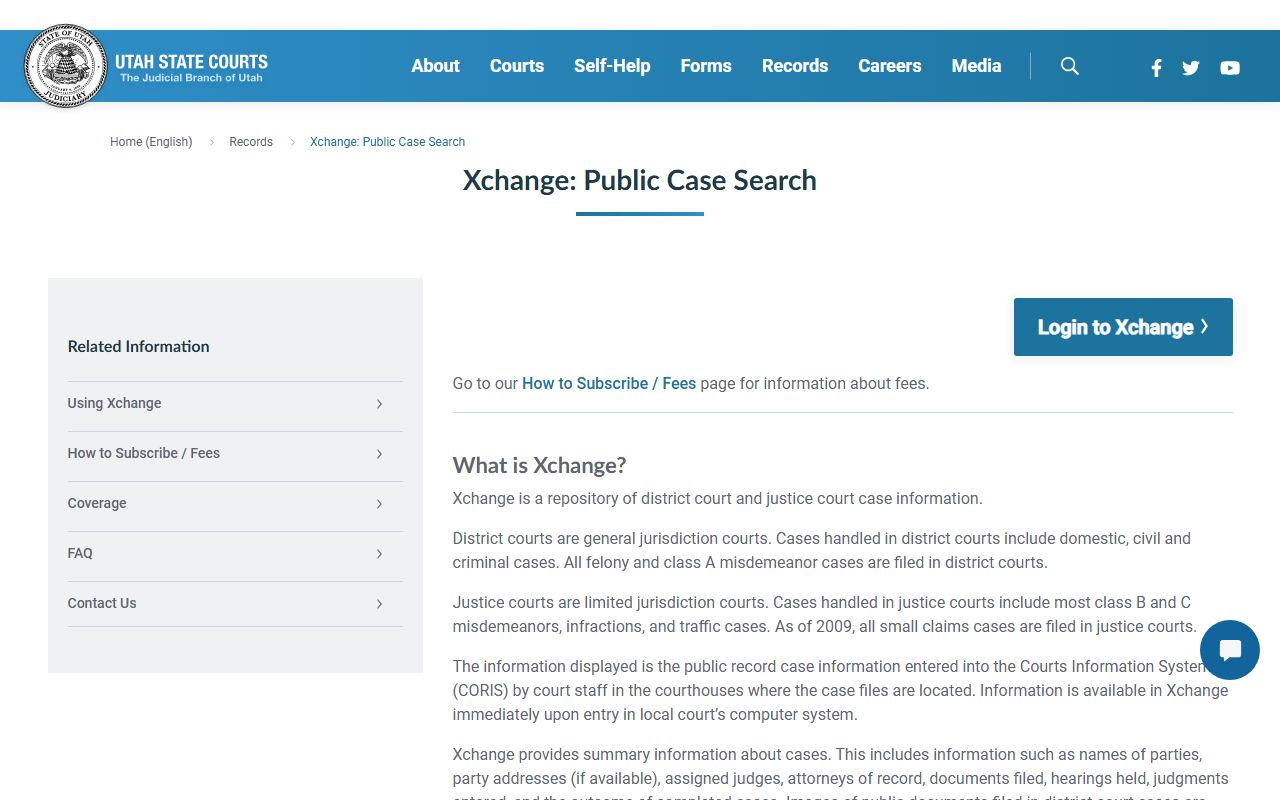
The Xchange source is useful because it states both what public case data may show and which sensitive or restricted case types are excluded.
Find Charges After Arrest
A practical Duchesne County court records after arrest search starts with the custody facts, then moves to the court file. A jail call may confirm whether the person is still held and whether a bond or hold is listed. The court record then shows whether the prosecutor has filed a complaint, information, or other charging document.
- Confirm current custody with Duchesne County Jail or Utah VINE if the arrest was recent and release or transfer is unclear.
- Identify the likely court. District court handles felony and class A misdemeanor filings, while justice court handles many class B and C misdemeanors, infractions, and traffic cases.
- Search Xchange by party name or case number after charges have had time to be entered by court staff.
- If the defendant is a party, use MyCourtCase for party-level access to filed papers, history, hearings, and payments.
- Call the appropriate court if online access is unavailable, the case is too new, or an older record may need a clerk or archives search.
Public terminals are available at most district court locations, according to Utah Courts. Older or historical court records may require the Utah Division of Archives court-record guide rather than a modern web portal. A narrow search works best: full legal name, date of birth, arrest date, citation or case number, and the arresting agency can help separate people with similar names.
Duchesne County Charging Documents
Booking charges are not always the charges that drive a Duchesne County court record after arrest. An officer may list suspected offenses during booking, but the county attorney decides what to file in court. Filed charges can be narrower, broader, amended, or dismissed. The charging document is the bridge from the jail arrest to the court case.
| Document | Who Uses It | What It Does | What to Check |
|---|---|---|---|
| Complaint | Often filed by prosecutor or officer process | Starts many criminal cases and states the alleged offense facts. | Charge level, statute citation, date, probable-cause language, and assigned court. |
| Information | Prosecutor | Formal prosecutor-filed accusation used in many felony and misdemeanor matters. | Whether charges were changed from the booking entry and whether counts were added or reduced. |
| Indictment | Grand jury process | Formal accusation returned through a grand jury route, less common in ordinary local filings. | Count list, allegation dates, and whether the case follows a different procedural track. |
Images of public district court documents may be available for purchase through Xchange when the case and document qualify. If a filed document is not visible, contact the clerk or review the court's records request options. A missing document image does not always mean no case exists. It may mean the record is newly filed, restricted, older, sealed, expunged, or not available through the public portal.
Duchesne County Charge Status
Charge status is often the most important part of court records after a jail arrest in Duchesne County. A case can begin with one set of accusations and end with a different result. Court entries may show amended counts, dismissals, convictions, acquittals, warrants, review hearings, sentencing, or probation terms. Read the status for each count, not just the case headline.
| Status | Plain Meaning | Why It Matters |
|---|---|---|
| Pending | The charge has been filed but no final disposition is entered. | Hearings, bond terms, or plea negotiations may still be active. |
| Amended | The filed charge was changed from its prior form. | The current charge may not match the booking entry or first complaint. |
| Reduced | The charge was lowered in degree or severity. | Potential penalties, court level, and background-record meaning may change. |
| Dismissed | The court or prosecutor ended that charge without a conviction on that count. | A dismissal is not the same as an expungement, so public access may still need review. |
| Convicted | A judgment was entered after plea or verdict. | The record now reflects a conviction, not just an accusation. |
| Acquitted | A not-guilty finding was entered. | The charge did not result in conviction, though records may still require sealing or expungement analysis. |
| Expunged | A qualifying record has been restricted from public inspection. | Utah Courts states expunged cases are not displayed on Xchange. |
Use docket dates to see the order of events. A dismissed count next to a convicted count has a different meaning than a wholly dismissed case. A warrant entry may explain why a person remained in custody even when a bond amount appeared elsewhere.
Bond and Holds After Arrest
Duchesne County's official jail pages reviewed in the research did not publish a full bond posting guide, bond desk schedule, accepted bond methods, or online bond link. That means bond information should be verified through Duchesne County Jail, the Sheriff's Office, the handling court, or the court record. Commissary deposits are not bond; the county jail page names JailATM for inmate-account deposits, which is a separate function.
A bond entry in a court record is only one part of release. A no-bond hold, warrant from another court, probation or parole hold, federal hold, immigration detainer, or transport issue can keep a person in custody even when a local case has a bond. Ask whether any hold exists before paying money or relying on a case-summary line.
| Release Term | How It Works | What to Confirm |
|---|---|---|
| Cash bond | Cash or certified funds secure release and appearance. | Amount, court, payment method, refund rules, and active holds. |
| Surety bond | A licensed bail agent posts bond through a contract and fee. | Utah licensing, contract terms, and whether the court accepts the bond type. |
| Personal recognizance | Release is based on promise to appear and follow court conditions. | Conditions, reporting rules, court dates, and no-contact orders. |
| No-bond hold | Release is blocked until a court or agency acts. | Which agency placed the hold and what event can clear it. |
| Detainer | Another agency asks the jail to hold or notify before release. | Whether the detainer is county, state, federal, parole, probation, or immigration based. |
Duchesne County Arrest Warrants
No official Duchesne County active-warrant search or most-wanted database was located in the official sheriff pages reviewed. Warrant questions usually need the issuing court, the Sheriff's Office, dispatch, or public court records. A bench warrant can appear in court history when it is public, while a sheriff record connected to warrant service may require a GRAMA request.
An arrest warrant authorizes custody based on a court order or probable cause. A bench warrant is usually issued by a judge for failure to appear or failure to comply. A fugitive warrant or hold can keep a person in Duchesne County Jail for another jurisdiction. A search warrant is different because it authorizes a search or seizure and may not mean the person has been booked.
Warrant caution: A person who may have an active warrant should confirm the issuing court and consider legal advice before appearing in person.
Court Records Comparison
Two distinctions prevent most mistakes in Duchesne County court records after an arrest. A charge is an accusation filed in court; a conviction is a final judgment after plea or verdict. Sealing and expungement also differ. Utah's expungement chapter is Utah Code Chapter 77-40a, while GRAMA access rules for government records appear in Utah Code Chapter 63G-2.
| Comparison | First Term | Second Term |
|---|---|---|
| Charge vs. conviction | A charge is an allegation filed in court and may be pending, amended, reduced, or dismissed. | A conviction is a judgment after a guilty plea, verdict, or other conviction event. |
| Sealed vs. expunged | Sealed records are hidden from ordinary public access by court order or rule. | Expunged records are restricted from public inspection under Utah's expungement process; Xchange does not display expunged cases. |
A dismissal, acquittal, or nonfiling does not always remove every public trace by itself. A person seeking to restrict qualifying arrest, investigation, detention, or court records must use the process that applies to the case and disposition. For booking photographs, Utah law adds separate limits and requester statements.
Duchesne County Court Contacts
The court and prosecutor contacts below are the local starting points for Duchesne County court records after a jail arrest. Use the court that matches the case type, and use the county attorney contact for prosecution-office routing rather than jail custody questions.
Duchesne County Attorney
P.O. Box 206
Duchesne, UT 84021
435-738-0184
Stephen Foote / Stephen D. Foote
8:30 a.m.-5:00 p.m., Monday-Friday except federal holidays
Eighth District Court Contact
21554 W 9000 S
Duchesne, UT 84021
435-264-4700
District court campus contact listed by Utah Courts for Duchesne County.
Duchesne County Justice Court
799 E 1260 N
Duchesne, UT 84021
435-738-0109
Appearances are by schedule only, according to the county justice court page.
The county attorney source page documents the local prosecutor contact.
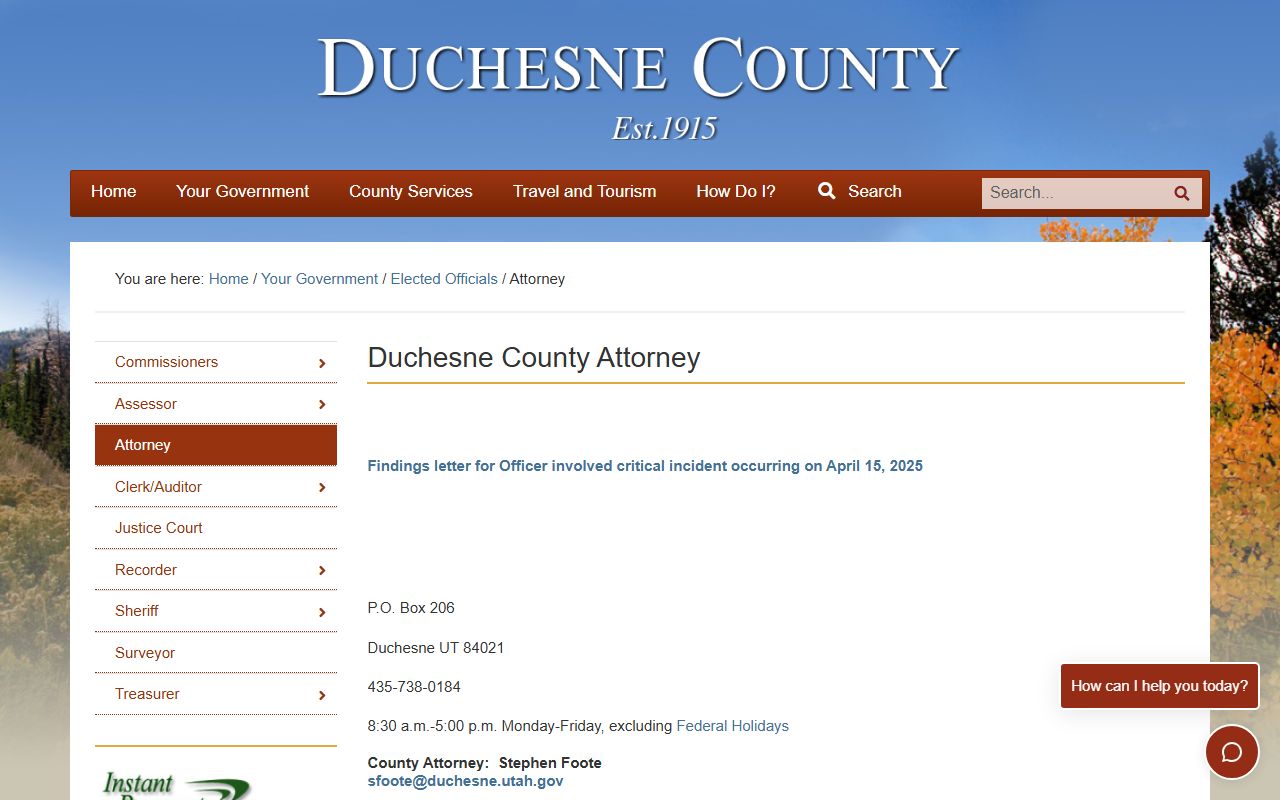
The prosecutor contact is most useful when the question is about filed charges, prosecution routing, or charging-document context, not whether someone is still in custody.